Compare

WarpStream vs. Amazon MSK:
Diskless Kafka vs. Managed Apache Kafka®

Both speak the Kafka protocol and run on AWS, so this isn't a compatibility decision. Amazon MSK runs Apache Kafka brokers on EC2 for you. WarpStream removes the brokers entirely and writes straight to your own S3 bucket. The difference shows up in what you pay for compute, storage, and cross-zone traffic, and in how much of Kafka you still operate.

TL;DR

Your Kafka clients work with both, so this is an architecture choice, not a compatibility one. MSK manages Kafka's brokers for you, but you still inherit Kafka's cost structure: an EC2 premium on every broker, EBS or per-GB storage, and cross-zone fees on producer and consumer traffic.

MSK still wins on raw latency, exact Apache Kafka compatibility, and native AWS integration. For most streaming workloads, WarpStream is dramatically cheaper and far simpler to operate.

CURRENTLY IN PRODUCTION AT

Already buying on AWS? Use your AWS credits or EDP discounts through AWS Marketplace.

The Core Difference:
Stateless Agents on S3 vs. Managed Brokers on EC2

Amazon MSK is managed Apache Kafka. AWS provisions the brokers, patches them, and handles upgrades. But architecturally it's still Kafka: stateful brokers that own partitions, data replicated across three zones, and capacity you scale in broker-sized steps.

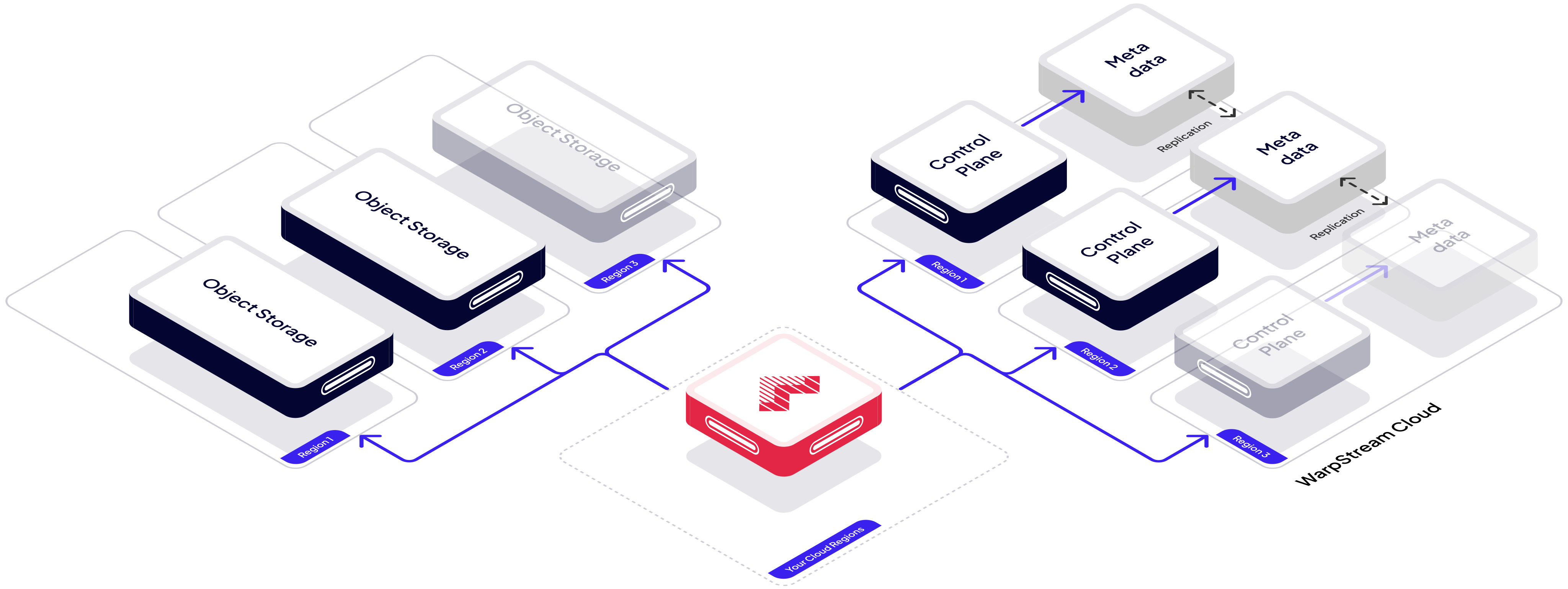
WarpStream removes the brokers. Stateless Agents write directly to object storage, so any Agent can serve any partition, and Agents come and go in seconds without moving data.

MSK doesn't charge for replication between its brokers. The cross-zone cost comes from your clients reaching partition leaders in other zones. WarpStream's zone-aware Agents only serve clients in their own zone, so that cost goes away.

Which MSK?
MSK has two cluster types, and the provisioned type has two broker options. This page compares all three.

‍Standard. You choose instance types and manage EBS storage. Most configurable, but most to operate.

‍Express. AWS's recommended default. Managed storage and faster scaling, but you still size brokers, and key settings are fixed.

‍Serverless. No brokers to size, but hard throughput, connection, and partition quotas.
Amazon MSK (Standard)
Your VPC (brokers run in AWS-managed infrastructure, ENIs in your VPC)
AZ-a
AZ-b
AZ-c
Producer
cross-zone $
Follower
EBS
Leader
EBS
Follower
EBS
Replication: no MSK charge
cross-zone $
Consumer
EC2 premium on every broker
WarpStream
Your VPC (Agents + bucket are yours)
Control plane: metadata only, zero access
AZ-a
AZ-b
AZ-c
Producer
Consumer
same zone
same zone
Agent
Agent
Agent
S3: system of record, cross-zone durability included
No brokers, no disks, no cross-zone clients

MSK replicates between brokers for free, but your clients still cross zones. WarpStream keeps clients in-zone and writes once to S3.

WarpStream vs. MSK at a Glance

WarpStream is Bring Your Own Cloud (BYOC). All three versions of MSK run entirely inside AWS-managed infrastructure.
Dimension
WarpStream
MSK Standard
MSK Express
MSK Serverless
Architecture
WarpStream
Diskless. Stateless, zone-aware Agents. S3 is the system of record.
MSK Standard
Stateful Kafka brokers on EC2s.
MSK Express
Stateful brokers with managed storage.
MSK Serverless
Brokers abstracted by AWS.
Storage
WarpStream
S3 only. Single tier.
MSK Standard
Provisioned EBS. Optional tiered storage.
MSK Express
Managed. Pay per GB.
MSK Serverless
Managed. Pay per GB. Per-partition quota.
Compute Sizing
WarpStream
None. Auto-scale on CPU.
MSK Standard
You pick instance type and count.
MSK Express
You pick instance size and count.
MSK Serverless
None.
Scaling
WarpStream
Seconds. No data movement.
MSK Standard
Slow. Partition reassignment.
MSK Express
Up to 20x faster than Standard. Still manual.
MSK Serverless
Automatic within quotas.
Throughput Limits
WarpStream
No hard cap.
MSK Standard
Bounded by broker count and size.
MSK Express
Per-broker quotas by size.
MSK Serverless
200 / 400 MBps per cluster. 5 / 10 MBps per partition.
Cross-Zone Networking
WarpStream
None for clients.
MSK Standard
Replication free. Clients billed.
MSK Express
Replication free. Clients billed.
MSK Serverless
Data in/out billed per GB.
Availability SLA
WarpStream
Up to 99.999% with Multi-Region Clusters.
MSK Standard
99.9%.
MSK Express
99.9%.
MSK Serverless
99.9%.
Multi-Region / DR
WarpStream
RPO=0 Multi-Region Clusters and Ripcord Mode.
MSK Standard
MSK Replicator (async).
MSK Express
MSK Replicator (async).
MSK Serverless
MSK Replicator (async).
Configuration Control
WarpStream
Kafka-level configs. Managed control plane.
MSK Standard
Flexible.
MSK Express
Key settings fixed. 3 AZs required.
MSK Serverless
Least flexible.
Latency
WarpStream
Hundreds of ms. ~33ms median with Lightning Topics.
MSK Standard
Low.
MSK Express
Low.
MSK Serverless
Low.
Kafka Compatibility
WarpStream
Kafka protocol, transactions, compaction, and schema registry.
MSK Standard
Apache Kafka.
MSK Express
Apache Kafka. Kafka Streams partial.
MSK Serverless
Apache Kafka. IAM auth only.
Where It Runs
WarpStream
Any cloud, on-prem, or hybrid.
MSK Standard
AWS only.
MSK Express
AWS only.
MSK Serverless
AWS only.
Pricing Model
WarpStream
Public unit prices.
MSK Standard
Broker-hours + storage + transfer.
MSK Express
Broker-hours + per-GB written + storage.
MSK Serverless
Cluster- and partition-hours + data in/out.

The Cost Difference: The EC2 Premium, Storage, and Cross-Zone Clients

The EC2 premium. A kafka.m7g.large broker costs about 2.5x the same instance on plain EC2. That buys patching and upgrades, but it's a markup on commodity compute, and MSK clusters are usually sized for peak.

‍Storage. Standard stores every byte three times on provisioned EBS. Express bills per GB stored and per GB written. WarpStream stores one copy in S3.

‍Cross-zone clients. Replication between brokers is free, but producer and consumer traffic to leaders in other zones is billed. WarpStream's zone-aware Agents remove that line item.
You can check the math yourself.
WarpStream publishes its BYOC pricing and has a public cost calculator, so you can model your own workload up front. The calculator compares your workload against MSK Standard, Express, and Serverless side by side.
Use the Pricing Calculator
1 GiB/s Workload
Standard and Express
WarpStream
$25,966
MSK Express
$60,791
MSK Standard
$205,502
87% less than Standard · 57% less than Express

Monthly cost at 1 GiB/s, 7-day retention, 8,192 partitions. If Fetch from follower is not enabled, Standard and Express are respectively  88% and 70% more expensive than WarpStream.

100 MiB/s Workload
Serverless only, since 1 GiB/s exceeds its per-cluster quota
WarpStream
$3,480
MSK Serverless
$22,260
WS data plane
WS control plane
Cluster hrs
Partition hrs
Write
Read
Storage
84% savings vs. MSK Serverless

100 MiB/s uncompressed (~4x compression), 3x fan-out, 7-day retention, 4,096 partitions (requires a Serverless quota increase).

Scaling and Operations:
MSK Manages the Brokers, Not the Kafka

MSK handles provisioning, patching, and upgrades. It doesn't remove capacity planning, rebalancing, storage management on Standard, or the overprovisioning that comes from scaling being a deliberate operation. WarpStream Agents are stateless, so they autoscale on CPU with Kubernetes or ECS.
Scaling Down MSK Standard
1. Monitor load
Watch CPU, network, and partition counts to decide when to scale down.
2. Move partitions
Reassign partitions off the brokers you're removing with admin APIs or Cruise Control.
3. Remove brokers
Use the MSK console or CLI.
4. Verify
Confirm producers and consumers weren't disrupted.
Scaling Down WarpStream
Nothing to orchestrate. Agents are stateless, so your autoscaler removes them.
availabilityZoneSelector:
  enabled: true
  zone: "us-east-1a"
  nodeZoneLabel: topology.kubernetes.io/zone

MSK supports broker removal, but you orchestrate it. WarpStream has no brokers to remove.

MSK Serverless:
Simple Until You Hit the Limits

MSK Serverless is the lowest-ops way to run MSK and fits small or bursty workloads, dev, and staging. But it trades broker management for hard quotas, and it's priced for convenience.
200 MBps
Max ingress per cluster
400 MBps
Max egress per cluster
5 / 10 MBps
Ingress / egress per partition
3,000
Client connections
2,400
Partitions (increase by request)
10
Serverless clusters per account
Even within those limits, it's expensive: at 100 MiB/s, MSK Serverless runs about $22,260/month vs. $3,480 for WarpStream.

Is WarpStream Faster Than MSK?
No, and Here’s Why That’s OK

For the lowest possible latency, MSK wins: its brokers write to local storage. If you need single-digit or low-double-digit millisecond latency, that's a legitimate reason to stay on MSK.

Most streaming workloads don't. For the in-between cases, WarpStream's Lightning Topics reach ~33ms median produce latency on S3 Express One Zone.

Kafka Compatibility:
Both Strong, With Real Nuance.

MSK runs Apache Kafka's actual code. WarpStream is a Go implementation of the Kafka protocol, and your existing clients and connectors work unchanged.

Both are highly compatible with existing Kafka clients, tools, and connectors, and in most pipelines you won’t change application code to move to either.
What WarpStream supports
Transactions and exactly-once semantics, compacted topics, consumer groups, a massive library of free integrations, ACLs, and a Confluent-compatible schema registry.

AWS Integration, Portability, and Where Your Data Lives

The honest concession. MSK is native to AWS: IAM auth, CloudWatch, Glue Schema Registry, MSK Connect, Lambda triggers, and one AWS bill.

WarpStream runs in your AWS account too. Agents on your EC2, EKS, or ECS; data in your S3 bucket; your IAM policies. Glue schema validation, Tableflow to Athena, and AWS Marketplace billing.

Portability. MSK is AWS-only with no on-prem option. WarpStream runs on any cloud, on-prem, or hybrid, and Orbit bridges on-prem clusters to the cloud.
The answer to MSK Connect
Pipelines run inside the Agents you already operate, defined in YAML, with outputs like S3, SQS, Kinesis, and Lambda. No connector cluster.
input:
  kafka_franz_warpstream:
    topics: [ orders ]
pipeline:
  processors:
    - aws_lambda:
        function: enrich_order
output:
  aws_s3:
    bucket: my-bucket
1:00

WarpStream Is Enterprise-Ready by Default

Security
TLS, SASL/SCRAM, mTLS, SSO
Compliance
SOC 2 Type 1 and 2
Support
24x7 with response-time SLAs
Automation
Terraform, Helm, API, CLI, Datadog dashboard

Availability and Disaster Recovery

WarpStream's Pro tier SLA is 99.99%, and Multi-Region Clusters raise it to 99.999% with zero data loss (RPO=0), automatic failover, and no leader-election tuning. Ripcord Mode keeps Agents accepting writes even if the control plane is unreachable.

MSK's standard SLA is 99.9%, and cross-region replication runs through MSK Replicator, which is asynchronous.
Multi-Region Clusters: Agents write to object storage in three regions, coordinated by a replicated control plane

Migrating From MSK Is a Config Change, Not a Rewrite

Orbit, built into the Agents, replicates topics from MSK with offsets preserved, plus consumer groups, ACLs, and configuration, from a single YAML file. No separate replication service.
Oribit logo
1
Point Orbit at your MSK cluster.
2
Replicate topics, offsets, consumer groups, and ACLs.
3
Cut over producers one topic at a time.
“We switched from MSK to WarpStream and got three things at once: lower costs, a simpler architecture, and an implementation that was much faster than upgrading a major Kafka version.”
Kshitij Grover, Co-Founder and CTO, Orb
Not ready to migrate everything?
Point WarpStream at your existing MSK cluster and start where it helps most.
Read Replicas
Move analytics reads off your brokers.
Long Retention
Keep history in S3.
Disaster Recovery
A WarpStream failover target.
Iceberg Tables
Tableflow ingests from MSK.

When is WarpStream The Best Choice?

For the large majority of streaming workloads, WarpStream is the better fit:
Your workload is throughput- and cost-sensitive rather than latency-critical (logging, observability, analytics, ML pipelines, ETL).
Your MSK bill is growing faster than your data.
You're tired of capacity planning, rebalancing, and version upgrades.
You've hit, or expect to hit, MSK Serverless quotas.
You need a higher SLA or zero-data-loss multi-region support.
You want to run across VPCs, accounts, clouds, or on-prem.

The Honest Caveat

MSK may be the better choice for small, bursty workloads that fit comfortably within Serverless quotas, for workloads that need the lowest possible latency, and for teams whose top requirement is exact Apache Kafka behavior or deep AWS-native integration.

Explore WarpStream

FAQs

Don't see an answer to your question? Check our docs, or contact us directly.

Can I migrate from MSK to WarpStream without downtime?

Yes. Orbit replicates topics with offsets, consumer groups, ACLs, and configuration, so you can cut over topic by topic.

Can I buy WarpStream through AWS and use my AWS commitment?

Yes. WarpStream is on AWS Marketplace, where you can use AWS credits or EDP discounts.

Can I use WarpStream alongside MSK without migrating to WarpStream?

Yes. Use Orbit for read replicas, long retention, or disaster recovery, or Tableflow to build Iceberg tables from MSK.

Does WarpStream replace MSK Connect?

For the vast majority of pipelines, yes. WarpStream Managed Data Pipelines run inside the Agents with a short YAML config and connect to AWS services like S3, SQS, Kinesis, and Lambda.

Does WarpStream have lower latency than MSK?

No. MSK's disk-based brokers have lower latency. WarpStream Lightning Topics reach ~33ms median produce latency for workloads that need it.

Is WarpStream real Apache Kafka?

No. It's a Go implementation of the Kafka protocol, while MSK runs Apache Kafka itself. Existing clients and connectors work unchanged with WarpStream.

How does WarpStream's SLA compare to MSK?

WarpStream's SLA starts at 99.9% on its Fundamentals tier and goes up to 99.999% with Multi-Region Clusters (RPO=0) on its Enterprise tier. MSK's standard SLA is 99.9%, with asynchronous cross-region replication.

What are MSK Serverless's limits, and how does its cost compare?

200 MBps ingress and 400 MBps egress per cluster, 3,000 connections, and 5 / 10 MBps per partition. At 100 MiB/s, that's about $22,260/month for MSK Serverless vs. $3,480 for WarpStream.

How does WarpStream compare to MSK Express?

Express manages storage and scales much faster than Standard, but its brokers are still stateful, you still size them, and you pay per GB written on top of broker-hours.

Does Amazon MSK charge for cross-AZ replication?

No. MSK doesn't bill replication between its brokers. It does bill client traffic to and from the cluster, and much of that crosses zones. WarpStream's zone-aware Agents keep it in-zone, avoiding those costs entirely.

Is WarpStream cheaper than Amazon MSK?

For most workloads, yes. MSK's cost comes from an EC2 premium, EBS or per-GB storage and write charges, and cross-zone client traffic. In a scenario with 1 GiB/s, 7-day retention, and 8,192 partitions, WarpStream is 87% cheaper than Standard and 70% cheaper than Express.